
Specify Heavy-Lift Hydraulic Hose for Motion, Load, and Electrical Exposure
HGW Hydraulics on Jan 21st 2025
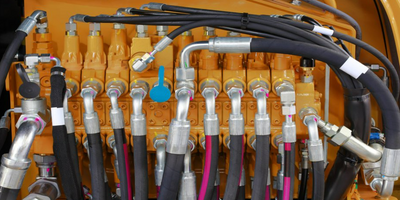
Hydraulic hose on lifting and material-handling equipment is both a pressure conductor and a moving machine component. Selection must cover the full duty: load-induced pressure, transients, articulation, ambient hazards, fluid, temperature, abrasion, electrical exposure and the way a failure could affect people or a suspended load.
A hose family name is not enough. The exact hose, ends and assembly process must be qualified together.
Translate machine motion into hose requirements
Aerial platforms, cranes, lift trucks, agricultural loaders, excavators, rescue tools and industrial lifts move hoses through changing positions. Map the smallest bend, twist risk, pull, rub point and distance to hot surfaces across the complete motion envelope.
Compare working pressure with the machine specification and expected transients. Include temperature at the fluid and hose exterior, compatible fluids, impulse duty and environmental exposure. The equipment maker may impose requirements beyond the hose construction standard.
Treat electrical classification as a documented property
Some thermoplastic hoses are manufactured in electrically nonconductive constructions for equipment operating near electrical hazards. Other thermoplastic hoses may be conductive or static-dissipative. Cover appearance and absence of visible wire do not prove insulation.
For utility aerial devices or similar work, require the exact electrical classification, test basis, end configuration, cleanliness and maintenance procedure specified for the equipment. Contamination, moisture, damage and conductive fittings can affect the complete assembly. Never substitute an ordinary hydraulic hose based on a general claim that thermoplastic is insulating.
Use SAE 100R7 and 100R8 as construction references, not universal ratings
SAE J517 includes thermoplastic hose types commonly known as 100R7 and 100R8. Individual products within those families can have different pressure by size, temperature range, conductive classification, compatible media and impulse performance.
R8 products are often used where a higher-pressure construction is needed, while R7 products cover many medium-pressure applications. Confirm the current manufacturer data and machine approval for the selected part number rather than carrying forward one temperature or pressure statement from another hose.
Control bend radius, twist, and end loading
Route the hose above its specified minimum bend radius and allow length for motion. A bend that begins immediately behind the coupling can overload the reinforcement and end attachment. Use guards, clamps, guides and strain relief where the machine design calls for them, without pinching the hose or forcing it against an edge.
Hose should flex in one plane when possible. Orientation marks can reveal twist during assembly and operation. Inspect every position, including transport, full extension and maintenance access.
Compare thermoplastic and rubber by the actual construction
Thermoplastic hose can offer a compact outside diameter, smooth cover, lower weight or tighter routing in some product families. Rubber hose remains appropriate for many severe hydraulic duties and may offer other advantages in impulse, abrasion or temperature service.
Cold flexibility, chemical resistance and fatigue life depend on tube, reinforcement and cover materials. Avoid universal statements that rubber becomes brittle or thermoplastic always tolerates flexing better. Use the tested data for the exact hose.
Qualify bonded multi-line assemblies carefully
Bonded or twinned thermoplastic lines can organize several circuits and reduce hose-to-hose rubbing. They may simplify installation on booms or lift mechanisms. The bundle must still permit the required relative motion and service access, and each line needs correct end orientation and identification.
If one line fails, the repair policy should state whether the complete bonded assembly or an individual line may be replaced. Do not let a compact bundle hide abrasion, heat exposure or minimum-bend violations.
Manage the assembly through its service life
Use compatible hose ends and a validated crimp or attachment specification. Record the hose, fitting, assembly date and any required proof or electrical test. Protect the line from contamination during storage and installation.
Inspect for cover cuts, blisters, exposed reinforcement, coupling movement, leaks, stiffness, kinks and changed routing. Isolate hazardous energy and support the load before work; never search for a pinhole leak with a hand.
Standard industrial air or water hose is not a hydraulic lifting hose. A suitable assembly is one whose documented pressure, motion, environment, electrical behavior and end connection all match the equipment.