
Matching Hydraulic Hose, Tube, and Fittings Across One Fluid System
HGW Hydraulics on Dec 23rd 2021
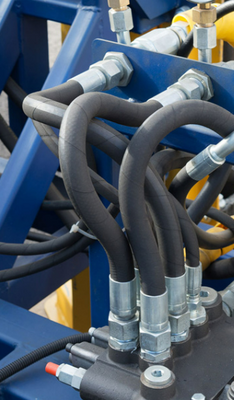
A hydraulic circuit can contain flexible hose, rigid tube, adapters, valves, pumps, cylinders, filters, sensors, and reservoirs. Each item may be correctly specified on its own and the finished line can still be wrong if the materials, ratings, sealing styles, or installed motion do not work together. Compatibility therefore has to be judged across the complete fluid path, not at the one fitting being replaced.
This matters in small assembly equipment as well as steel mills, earthmoving machinery, process plants, mining systems, and oil and gas equipment. The consequences differ, but the engineering question is the same: can every part of the route carry the intended media through the real pressure, temperature, movement, and environment without creating a weak point?
Map fixed and moving sections before selecting components
Start by tracing the circuit from one component port to the next. A supported steel or stainless tube can be practical along a stationary frame. Flexible hose may be needed where a cylinder moves, a power unit vibrates, or a service loop must be disconnected. Adapters bridge the port standard to the tube or hose end, but they also introduce sealing surfaces, orientation, and additional potential leak points.
The same plant can require very different combinations. A food-processing machine may use a hydraulic hose to operate moving equipment while a nearby stainless tube carries process media. A loader boom may use hose throughout the moving section because a rigid line could not follow articulation. A stationary power unit may use tube for long runs and short hose sections at the pump to isolate vibration. Treating all three routes as the same “hydraulic line” would overlook their different duties.
Support and routing are part of compatibility. Tube needs suitable clamps and allowance for thermal movement. Hose needs enough length for motion without being pulled, twisted, rubbed, or bent below its specified radius. A fitting elbow may solve an orientation problem, but only when its seat, thread, material, and rating match both sides of the connection.
Let the hardest service condition control the decision
Remote and severe-duty equipment shows why component selection cannot be reduced to thread size. A subsea processing package can combine sand separation, water removal, multiphase boosting, and fluid separation thousands of feet below the surface. Some units can weigh close to 1,000 tons. Bringing that equipment back to the surface for routine correction is extremely expensive, so access, corrosion exposure, contamination control, and planned service interval influence every hose, tube, fitting, and seal choice.
A factory line has easier access, but downtime can still stop an entire process. Mobile equipment adds shock, abrasion, weather, and repeated flexing. Chemical or washdown areas add external exposure that may attack a hose cover or fitting finish even when the internal hydraulic fluid is compatible. The correct combination is the one that fits the actual failure consequences and maintenance environment.
Use the lowest applicable component rating for the assembly. A high-rated hose does not raise the rating of a lower-rated end fitting, adapter, port, or seal. Normal working pressure is only one input; the design review also has to consider pressure spikes and the equipment manufacturer's limits.
Use STAMPED as a recorded specification, not a memory aid
STAMPED collects eight categories: Size, Temperature, Application, Material or Media, Pressure, Ends, and Delivery. Its value comes from recording specific answers rather than simply checking off the letters.
Application should describe motion, vibration, routing, abrasion, installation access, duty cycle, and the consequence of leakage. It also establishes whether the line should remain flexible or whether supported tube is more appropriate.
Material or media covers the fluid inside the line and the environment outside it. Check the hose tube, fitting body, plating, O-rings, and any tube material against hydraulic oil, water-glycol fluid, process media, cleaning chemicals, saltwater, ultraviolet light, ozone, or other exposure that applies.
Pressure includes the system working pressure and credible transient conditions. Confirm the exact hose series, fitting system, adapter, and component port rather than applying one catalog value to a mixed assembly.
Size includes hose inside diameter, tube outside diameter and wall, fitting size, and finished assembly length. An undersized bore can increase velocity, pressure loss, and heat. An assembly cut too short can load the fitting when the machine moves; excess length can create rubbing or an uncontrolled bend.
Temperature means both the conveyed fluid and ambient surroundings. Heat can accelerate elastomer aging, while cold can reduce flexibility. A PTFE-based hose may cover a different temperature and chemical range than a common rubber hydraulic hose, but it also has its own bend, fitting, and handling requirements.
Ends identifies both terminations completely: connection family, male or female, thread size and pitch, sealing surface, orientation, attachment method, and port standard. A thread that starts by hand is not proof that the seal is compatible. JIC, ORFS, ORB, NPT, BSP, DIN, and other connections seal in different places.
Delivery covers the condition in which the parts reach assembly and field service. Clean components, protected ends, correct labels, and controlled storage reduce the chance that dirt, moisture, or a wrong revision enters the system before installation.
Check the interfaces where different components meet
Compatibility problems often appear at transitions. A hose stem and ferrule must be approved for the exact hose construction and crimp specification. A tube fitting must match tube outside diameter, wall, material, and preparation. An adapter must match the seal on each end rather than simply converting two nominal thread sizes.
For replacement work, preserve the original routing and orientation unless a documented engineering change has been approved. Record the old part markings, measure the connection, inspect the mating port, and identify why the original line was removed. If the failure came from abrasion or tension, installing an identical new hose in the same route will reproduce the problem.
Version control also matters when equipment has been modified. A drawing may show the original port while the machine in service contains a later adapter or replacement valve. Photos, dimensions, equipment serial context, and the current assembly should be reconciled before ordering.
Cleanliness and traceability complete the assembly
The line is not ready merely because it holds together. Cutting and assembly can introduce rubber particles, metal chips, oil, or dust. Caps should remain in place through transport and storage, and any specified cleaning process should be completed before the line is connected to sensitive valves, pumps, or actuators.
Keep enough identification to trace the hose type, fitting family, assembly specification, and relevant batch or work record. For U.S. inventory planning, frequently used sizes can be stocked locally while uncommon combinations are controlled against drawings and replenishment records. That approach supports faster maintenance without treating visually similar parts as interchangeable.
A reliable hydraulic route is the result of compatible components and compatible conditions. Mapping the system, documenting STAMPED inputs, checking every transition, and protecting cleanliness creates a stronger basis for selection than choosing a hose, tube, or fitting in isolation.