
Selecting Hydraulic Hose by Construction, Routing, and Duty Cycle
Apr 18th 2023
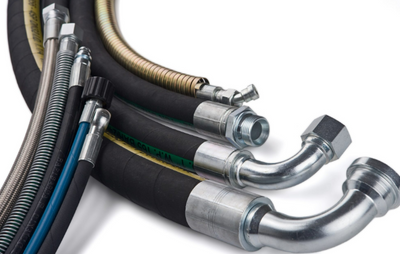
Hydraulic hose carries fluid between pumps, valves, cylinders, motors, and other moving or difficult-to-pipe components. Its job is not defined by pressure alone. The same assembly must contain the fluid, tolerate heat and impulse, fit the route, resist the external environment, and work with the specified ends.
That makes hose selection a system decision. Begin with the required bore and service conditions, then choose a construction whose tube, reinforcement, and cover address those conditions. Family names such as “thermoplastic” or “spiral wire” help narrow the search, but the applicable hose specification and manufacturer data must complete it.
Read a hose from the inside outward
The inner tube contacts the hydraulic fluid. Its compound must be compatible with the oil, water-based fluid, or other approved medium across the operating temperature range. Swelling, hardening, softening, or extraction of tube material can contaminate the circuit and undermine the assembly.
Reinforcement carries pressure load and controls expansion. Textile braid, wire braid, spiral wire, and high-strength synthetic reinforcement respond differently to pressure impulse, bending, weight, and routing. More reinforcement is not automatically better if it creates an unsuitable bend radius or assembly.
The cover protects against abrasion, ozone, weather, oil splash, chemicals, and handling. A cover selected for a clean indoor power unit may fail quickly where a mobile hose rubs against a frame. Guarding or rerouting may be necessary even with an abrasion-resistant cover.
Use SAE designations as construction requirements
SAE 100R hose designations identify construction and performance requirements; they are not a single ladder from weak to strong. The correct designation depends on the system. Always verify the current standard, the hose manufacturer’s specification, and the exact assembly components rather than choosing from the R-number alone.
SAE 100R4 is commonly associated with suction and return service and uses reinforcement designed to resist collapse. SAE 100R6 is a textile-reinforced hose used in appropriate lower-pressure applications. Neither description authorizes every hose with that label for every petroleum- or water-based fluid; compatibility and temperature remain product-specific.
Dash size usually represents nominal hose inside diameter in sixteenths of an inch. For example, -8 commonly indicates a nominal one-half-inch bore. This convention does not replace dimensional verification, especially for specialty hose, metric systems, or assemblies with restricted end fittings.
Compare constructions by the work they perform
Textile-reinforced and lower-pressure lines
Return, drain, suction, lubrication, and other lower-pressure functions may use textile-reinforced or suction-specific hose. Vacuum resistance, kink resistance, and the possibility of collapse can be as important as positive pressure. A return line should not be selected solely because its average gauge pressure is low.
Thermoplastic hose
SAE 100R7, 100R8, and 100R18 are common thermoplastic hose families. Thermoplastic constructions can provide a compact outside diameter, low weight, chemical resistance, and useful low-temperature flexibility, depending on the product. They appear on machine tools, lifts, mobile equipment, and other medium- or higher-pressure circuits.
Some thermoplastic hoses are designed to be nonconductive. That property must be explicitly specified and preserved with the correct ends and assembly process. The appearance of a plastic cover does not prove electrical isolation.
Spiral-wire hose
Spiral-wire constructions are used where high working pressure, severe impulse, and demanding mobile-equipment duty require multiple wire layers. SAE 100R13 is one example of a multi-spiral specification. Agricultural, forestry, mining, and construction equipment may use these designs where pressure cycles and external loads are severe.
Spiral layers and separating plies are engineered as a unit. A multi-spiral hose normally requires its approved stem, ferrule, preparation method, and crimp specification. Substituting a convenient end from a braided-hose system is unsafe even when the nominal size matches.
Apply STAMPED to the actual route
STAMP is often expanded to size, temperature, application, media, and pressure. Many selection processes add ends and delivery, producing STAMPED. Each item changes the final assembly.
- Size: Determine bore from required flow and acceptable velocity or pressure loss. Check the actual end-fitting passage as well as hose ID.
- Temperature: Consider internal fluid temperature, ambient heat, cold starts, radiant heat, and localized hot surfaces. Use the manufacturer’s combined limits.
- Application: Record movement, impulse frequency, bend radius, abrasion, vibration, vacuum, electrical exposure, and installation space.
- Media: Check the tube, cover, seals, cleaning agents, and external chemicals against reliable compatibility data.
- Pressure: Include normal working pressure, spikes, surge, and vacuum. Do not use burst pressure as allowable working pressure.
- Ends: Match fitting series, connection standard, orientation, and crimp data to the exact hose.
- Delivery: Define length, cleanliness, protection, labeling, testing, packaging, and required documentation.
Avoid three common selection shortcuts
First, do not replace a hose only by its outside diameter. Different constructions can share a similar OD while having different bores, pressure capability, or bend behavior. Second, do not treat flexibility in the hand as proof of an adequate bend radius in motion. Third, do not assume a higher pressure rating corrects incompatibility with fluid or temperature.
For an installed assembly, record every readable marking before removal. Note route, clamp locations, bend direction, abrasion points, port standards, end orientation, and equipment function. If the marking is incomplete, use the machine documentation or an approved replacement specification rather than reverse-engineering safety-critical performance from appearance.
The best hydraulic hose is the construction that satisfies the complete duty cycle and can be assembled with a controlled, documented end-fitting system. That definition is more useful than choosing the heaviest hose or the most familiar SAE number.