
Where Hydraulic Power Fits in Eight Manufacturing Machines
HGW Hydraulics on May 7th 2025
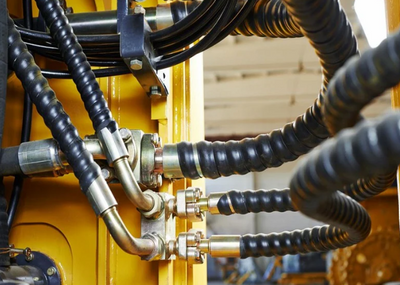
Hydraulic power converts mechanical input at a pump into controlled fluid pressure and flow, then into force or torque at a cylinder or motor. Manufacturing equipment uses that capability where high force, compact actuators, load holding, or controlled motion justify a fluid-power system.
Hoses, tubes, manifolds, fittings, filters, reservoirs, valves, sensors, accumulators, and cooling all support the actuator. The machine application determines which circuit architecture and connection details are required.
Open and closed circuits are hydraulic flow architectures
In an open-circuit system, the pump draws from a reservoir and return flow normally goes back to the reservoir. Directional valves route flow to cylinders or motors. Reservoir volume supports cooling, air release, and contamination settling/filtration.
In a closed hydrostatic circuit, return flow from a motor travels back toward the pump in a loop, with charge, cooling, flushing, and makeup functions as required. This is different from “open-loop” and “closed-loop” control terminology about sensor feedback. A hydraulic press with position feedback can be closed-loop controlled while still using an open hydraulic circuit.
Contamination behavior is not inherently better in one architecture; filtration, component sensitivity, flushing, fluid handling, and maintenance control cleanliness.
1. Forging presses create controlled forming force
Large cylinders move a ram against hot or cold workpieces. Pressure, flow, frame stiffness, die alignment, decompression, and heat management influence repeatability. Flanges and large lines need support against impulse and vibration.
2. CNC machines clamp tools and workpieces
Hydraulic workholding can provide repeatable clamp force in compact fixtures. Small passages and valves make cleanliness important. A pressure switch may confirm clamping before machining, but the safety logic must account for leakage and stored energy.
3. Die-casting machines clamp and inject
Hydraulics can close dies and drive high-speed injection functions. Accumulators may supply peak flow, creating stored-energy hazards. Heat, fire-resistant fluid requirements, and contamination from the casting environment need review.
4. Material handling lifts and moves loads
Forklifts, cranes, lift tables, conveyors, and transfer equipment use cylinders and motors. Load-holding valves, hose routing, mobile connections, braking, and mechanical blocking protect raised loads. A hose must never be the only support during maintenance.
5. Stamping presses apply force through a stroke
Hydraulic and servo-hydraulic presses can control force and motion profiles for forming. Guarding, two-hand controls, safety-rated logic, decompression, and die protection belong to machine design beyond the hydraulic circuit.
6. Press brakes synchronize bending cylinders
Position sensing and valve control can coordinate left and right cylinders. Tube and hose routing must accommodate beam motion without side-loading ports. Drift or uneven motion can reflect hydraulic, control, or mechanical causes.
7. Punch presses drive repeatable tooling
Hydraulic cylinders power a punch through material and return it. Shock, pressure spikes, die condition, and cycle heat affect the system. Correct filtration and cooling protect valves used for fast sequencing.
8. Robotic and positioning systems use hydraulic actuators selectively
Hydraulic robots and manipulators offer high force-to-size performance in harsh or heavy-duty work. Many factory robots are electric, so do not assume every robotic arm is hydraulic. Where fluid power is used, hose articulation, servo-valve cleanliness, sensor feedback, and emergency motion control are critical.
Connections translate the architecture into reliable hardware
Choose JIC, ORFS, ORB, flanges, metric, BSP, tube fittings, or hose ends from equipment standard, pressure, movement, leakage consequence, and service access. Support lines, maintain bend radius, and protect them from chips, weld spatter, heat, and moving tooling.
Inspect pressure, temperature, filter condition, fluid analysis, leaks, actuator drift, hose abrasion, clamps, and valve response. Lock out and dissipate stored energy before service.
Manufacturing hydraulics is not one generic pump-cylinder diagram. Each machine uses fluid power for a different force and motion problem, and its circuit, controls, connections, and safety measures must be designed around that job.