
Choose Hydraulic or Pneumatic Power from Load, Motion, and Facility Energy
HGW Hydraulics on Feb 6th 2024
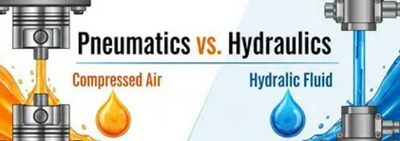
Hydraulics and pneumatics both transmit energy through fluid, but liquid and compressed gas respond differently. The useful decision begins with required force, speed, position behavior, duty cycle, environment, and the energy sources already available at the facility. Neither technology is automatically cleaner, safer, cheaper, or more precise in every design.
Convert the motion requirement into force and flow
Hydraulic circuits use a liquid with relatively low compressibility, allowing compact actuators to develop high force and hold or control heavy loads when the complete system is designed for it. Construction equipment, presses, lifting machinery, steering, and industrial motion often benefit from that power density.
Pneumatic actuators use compressed air or gas. They are common for rapid repetitive movement, clamping, packaging, pick-and-place, and automation where loads and position requirements fit the actuator. Compressibility provides compliance but can also make stiffness and steady low-speed control more challenging.
Calculate force, stroke, speed, acceleration, cycle frequency, holding requirement, and load changes. Do not choose hydraulics from “heavy” or pneumatics from “fast” without sizing valves, conductors, actuators, and controls.
Compare control behavior at the machine
Hydraulic flow and pressure control can support smooth high-force motion, but friction, leakage, fluid compressibility, temperature, valve behavior, and control architecture still affect accuracy. Servo or proportional components require clean fluid and proper tuning.
Pneumatic positioning can be improved with proportional valves, feedback, brakes, and appropriate actuator sizing. Air cushioning and compliance may be an advantage when contacting delicate parts. A simple on-off cylinder is different from a closed-loop pneumatic axis, just as a basic hydraulic valve is different from an electrohydraulic servo.
Count energy at the compressor or pump
Compressed air is convenient at the point of use but can be expensive to generate. Compressor losses, pressure drop, drying, treatment, and leaks affect facility energy. An air leak is not a free or harmless event simply because the medium is air.
Hydraulic systems incur pump, motor, throttling, standby, cooling, and leakage losses. Variable-displacement pumps, accumulators, load-sensing controls, proper line sizing, and duty-based operation can change efficiency. Compare measured or calculated energy over the actual cycle rather than claiming one technology is always more efficient.
Plan contamination and leakage controls
Hydraulics need compatible fluid, filtration, cleanliness, temperature control, reservoir care, and leak management. A hose or seal failure can release hot pressurized fluid and create cleanup or environmental concerns.
Pneumatics need suitable air quality, filtration, water management, dryers or lubrication where specified, and exhaust control. Oil-free process requirements are not guaranteed merely by using air; compressors, piping, and ambient intake can introduce contaminants. Exhausted air can spread noise, particles, or process material.
Compare maintenance by failure mode
Hydraulic maintenance covers fluid condition, filters, hoses, fittings, pumps, valves, cylinders, coolers, and contamination control. Pneumatic maintenance covers compressors, receivers, dryers, filters, regulators, lubricators where used, tubing, fittings, valves, cylinders, silencers, and leak surveys.
Pneumatic systems may be mechanically simple at the machine, while the shared compressor plant remains a major system. Hydraulic equipment can offer long service in harsh mobile duty but needs disciplined fluid and hose care. Use site capability and spare strategy rather than a blanket low-maintenance label.
Address safety for both energy forms
Hydraulic stored pressure, raised loads, hose injection, hot oil, and component movement require controlled isolation and blocking. Pneumatic receivers and trapped air also store energy; separated components can move or become projectiles, and exhaust or compressor noise can injure.
Apply machine guarding, pressure relief, rated components, energy-control procedures, and safe exhaust or leak detection appropriate to the design. Air does not make a system inherently safe, and liquid does not make it inherently dangerous.
Compare total installed and lifecycle cost
Pneumatics may be economical when a suitable compressed-air plant already exists and the task uses modest energy intermittently. Adding compressor capacity, dryers, distribution, and continuous air demand can change the result. Hydraulics may have higher component and fluid-management costs but deliver compact high force that avoids oversized alternatives.
Include actuators, power unit or compressor share, valves, conductors, treatment, controls, cooling, noise reduction, maintenance, energy, leakage, downtime, and environmental handling. Hybrid machines can use each technology where it fits.
The correct choice is the system whose measured load, motion, facility energy, environment, safety controls, and lifecycle resources align. That engineering record is stronger than assigning hydraulics to power and pneumatics to speed as universal rules.