
Matching Agricultural Hydraulics to Machines, Implements, and Field Conditions
HGW Hydraulics on Nov 13th 2025
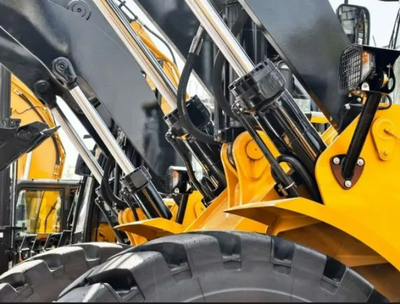
Agricultural hydraulics must do more than move a cylinder in a controlled shop. A tractor may connect to implements from different manufacturers, work far from service support, run through dust and crop residue, and change jobs several times in one season. The practical advantage of fluid power is its ability to deliver controllable force to many machine functions; the design challenge is making those functions compatible and serviceable in the field.
Harvesting combines many hydraulic duties on one machine
A combine performs cutting, conveying, threshing, separating, cleaning, and grain handling in one pass. Hydraulic circuits can position the header, control reel functions, steer the machine, drive auxiliary mechanisms, and support unloading. Forage harvesters add cutterhead, feed-roll, spout, and blower functions in either self-propelled or tractor-powered arrangements.
These functions do not all need the same flow or pressure at the same moment. Priority, load sensing, accumulator behavior, and valve response affect whether steering remains available while another function moves. Hose routing must allow header travel and articulation without rubbing, pulling at the fitting, or falling below minimum bend radius.
Sprayers combine motion control with chemical exposure
Hydraulics can fold and level booms, drive pumps or fans, steer, and adjust height on a crop sprayer. Uniform application depends on stable machine motion and process control, but the hydraulic circuit is also exposed to moisture, fertilizer, cleaning chemicals, sun, and fine contamination.
Connection material and finish should be selected for the actual environment and fluid exposure rather than a generic corrosion label. Inspect areas where chemical residue can collect. Keep hydraulic leaks separate from the product-delivery problem: a boom-position circuit and the chemical spray circuit may use different fluids, materials, seals, and cleaning procedures.
Loaders, skid steers, and telehandlers trade speed for controlled force
Track loaders and skid steers use hydraulic motors for propulsion and cylinders for lift and tilt. Their ability to push, dig, handle bales, clear brush, or move material comes with frequent direction changes, shock, dust, and attachment swaps.
Telehandlers add a telescoping boom and changing load geometry. Stabilizers, steering modes, forks, buckets, and auxiliary attachments can alter the operating condition. A replacement hose or adapter must preserve routing clearance through the full boom movement, not only when the machine is parked.
The tractor-to-implement interface is the compatibility boundary
Tractors provide hydraulic power to balers, planters, spreaders, harrows, mowers, forestry attachments, and other implements. A coupler may physically connect even when the implement’s flow requirement, return path, valve type, or backpressure limit does not suit the tractor.
Record the tractor model, implement model, pump type, available flow, remote-valve arrangement, coupler standard, pressure and return requirements, and whether a case-drain or free-return line is specified. A motor case drain must not be treated as an ordinary pressurized return. Incorrect routing can damage a motor seal even when supply flow seems adequate.
Cross-brand combinations deserve special attention because both products may be correct individually while the combined operating point is poor.
Open-center and closed-center describe circuit behavior
In an open-center arrangement, a fixed-displacement pump commonly sends flow through the valve’s neutral path back to tank. When a function is commanded, the valve redirects flow to the actuator. Continuous flow and throttling affect heat and how multiple functions interact.
Closed-center systems block or greatly reduce neutral flow at the valve and often use a variable-displacement or pressure/flow-compensated pump. Load-sensing systems adjust pump output from a demand signal. These are broad architecture descriptions; the actual schematic and manufacturer instructions control how an implement should be connected.
An implement valve designed for one architecture may make another system run hot, remain on standby at high pressure, or respond poorly. Conversion plugs and valve options should only be used when the equipment documentation supports the configuration.
Field reliability depends on identification and contamination control
Dust on a quick coupler can enter the circuit during every attachment change. Clean both halves before connection, cap disconnected ends, and replace damaged caps. Do not use a tool that can score the sealing surface.
For an unknown fitting, record both ends, thread outside diameter, pitch, seat style, tube or hose size, body shape, material, and seal. Metric, BSP, JIC, ORB, and pipe-thread connections may look close after dirt and paint hide their details. A forced near-match can damage the mating port and delay the repair.
Mark verified replacements by machine and function, while retaining the original part drawing or cross-reference evidence. Common wear items may justify local stock; rare adapters can remain controlled-order parts. This prevents a broad spare inventory from becoming a box of unidentified near-matches.
Maintenance should follow motion and season
Inspect hoses with the implement raised, lowered, folded, steered, and articulated according to the safe service procedure. Look for abrasion, hardening, exposed reinforcement, wetness, crushed guards, loose clamps, corrosion, and fitting movement. Relieve stored pressure before disconnecting an implement and support raised equipment mechanically as required by the manufacturer.
Seasonal storage adds moisture, temperature cycling, rodents, and long periods without movement. Clean exposed connectors, install caps, protect routed hoses from sharp bends, and document defects before the next busy period.
Agricultural productivity does not come from hydraulics in the abstract. It comes from matching pump supply, valve architecture, implement demand, connectors, routing, and maintenance to the actual farm task. That system view lets one tractor support varied work without turning every attachment change into a compatibility experiment.