
Protecting Hydraulic Connections on Mining Excavators, Loaders, and Water Equipment
HGW Hydraulics on Jan 8th 2025
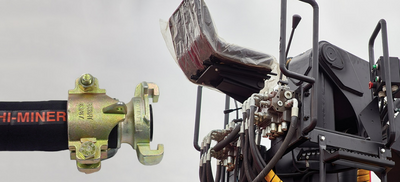
Mining equipment combines high loads with dust, rock impact, vibration, weather, heat, wash water, and limited maintenance windows. A hydraulic hose that works on a clean power unit can fail quickly when it rubs a boom, is crushed by debris, or is pulled tight through articulation.
Connection reliability begins with the machine’s motion and exposure. The fitting, hose, guard, clamp, and route should be reviewed as one assembly rather than adding a protective sleeve after damage appears.
Map motion before selecting protection
Excavators, shovels, loaders, drills, haul equipment, crushers, conveyors, and support vehicles place hoses near cylinders, pivots, attachments, tracks, engines, and operator-maintained points. Cycle the equipment through its permitted range under a controlled procedure and identify stretch, twist, pinch, bend, and contact zones.
Check minimum bend radius, slack, clamp spacing, and end orientation. A sleeve does not correct a hose that becomes taut at full extension or twists every cycle. Heavy adapter stacks can add leverage at a port.
Separate abrasion, impact, heat, and fluid-injection risks
Spiral guard, textile sleeve, spring guard, molded protector, bend restrictor, shielding, or rerouting each addresses a different hazard. Abrasion protection needs to remain at the contact point. Impact protection must tolerate the expected debris without trapping material against the hose.
Near engines, exhaust, hot process lines, or fire risk, use protection specifically qualified for the thermal exposure. A general abrasion sleeve is not automatically a fire sleeve. Line-of-sight guarding may be required where personnel could be exposed to a pinhole jet.
No guard raises the working pressure of the hose assembly. The exact hose, ends, crimp, fluid, and temperature define that limit.
Excavation and loading equipment need articulation control
Boom and bucket circuits flex repeatedly while carrying changing pressure. Hoses can rub adjacent lines, strike structure, or bend sharply near a fitting. Clamps should control the bundle without crushing it and should allow necessary movement.
At attachment changes, quick couplers need clean caps, compatible profiles, pressure relief, and positive locking. Trapped pressure and contamination are common risks; follow the machine procedure rather than forcing the halves.
Inspect fittings for looseness, corrosion, impact, and wetness, and inspect hose covers before reinforcement is visible.
Water cannons and dust-control systems have different media needs
Mining water trucks and cannons may use hydraulic circuits for aiming and separate water piping for flow. Identify which hose carries hydraulic oil and which carries water; their constructions, ends, corrosion exposure, and failure consequences differ.
Water, treatment chemicals, outdoor storage, and mine dust can attack external fittings. Material and finish should suit the actual water chemistry and environment. Do not substitute a hydraulic hose for a water-delivery hose or vice versa based only on diameter.
Preventive inspection follows severity
Set inspection intervals from equipment duty, movement, exposure, hose age, and manufacturer requirements rather than a universal calendar. Clean enough dirt to see the cover and fitting, then look for abrasion, cuts, cracks, hardening, blistering, corrosion, leaks, crushed guards, loose clamps, and changed routing.
Record the exact machine location and orientation before removal. Cap ports and hoses immediately to control contamination. A replacement should match hose series, ID, ends, length, orientation, working conditions, and approved assembly specification.
Never inspect a suspected high-pressure leak with a hand. Lower and block attachments, shut down, lock out, and relieve stored pressure before service.
Use failure evidence to improve the route
A worn spot on every replacement indicates a persistent contact point. Damage near the fitting may signal an overly tight bend, missing support, or movement concentrated at the stem. A burst after heat exposure requires examination of shielding and hose temperature limits, not only a new assembly.
Track failure location, hours or cycles where available, operating event, fluid condition, and corrective action. This turns hose replacement into a route improvement program.
Mining hydraulic protection is effective when it addresses the exact mechanical and environmental hazard at each machine location. The durable solution may be a guard, a clamp, a different route, a compatible material, or a redesigned connection—and often a combination of them.