
Place ORFS Where It Removes Adapters and Preserves Instrument Accuracy
HGW Hydraulics on Dec 26th 2023
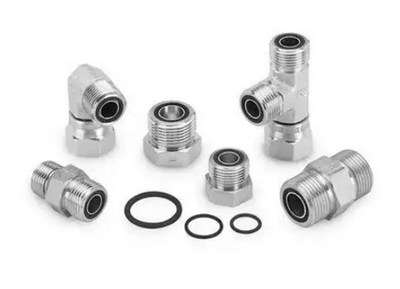
ORFS is most useful when a flat O-ring face can connect a hose or tube directly to the component and remove unnecessary conversions. Fewer adapters can reduce installed length and the number of joints, but only when the meter, valve or equipment port is actually available and qualified with that interface.
The connection choice must preserve the component's hydraulic function as well as contain fluid.
Begin with mobile-equipment motion
Construction and agricultural machines cycle cylinders, steer, articulate and vibrate while operating outdoors. ORFS can provide a serviceable elastomeric face seal in these circuits when hose routing, supports and end orientation are correct.
It cannot compensate for a twisted hose, unsupported adapter stack or wrong O-ring compound. Inspect faces and seals whenever repeated machine motion produces seepage near a joint.
Protect the measurement path at a flow meter
A turbine meter infers flow from rotor motion in its calibrated flow path. Adapters, reducers and elbows near the meter can alter pressure loss, flow profile, straight-run requirements or installation length.
An ORFS-ended meter may remove NPT conversion joints and fit a compact layout. Before changing ends, confirm meter calibration basis, permitted orientation, bore, pressure and temperature rating, media, cleanliness and the manufacturer's installation requirements.
Reduced adapter count does not automatically improve accuracy. A smaller ORFS adapter or poorly placed elbow can disturb the measurement even while remaining dry.
Apply the same logic to industrial auxiliaries
Lube-oil skids, hydraulic control packages, jacking or leveling circuits, wind and hydroelectric auxiliaries, wellhead panels, industrial machines and water-treatment equipment can all use face-seal connections.
These services differ in fluid, contamination tolerance, vibration and seal chemistry. “Common application” only establishes where to investigate; it does not authorize one ORFS material or pressure class across the list.
Verify the standard and complete assembly
SAE J1453-family specifications cover defined ORFS interfaces and performance requirements. Select the exact size, body and hose or tube end from current product data.
The O-ring groove, compound, mating face, nut and attached conductor form one connection. Record working and transient pressure, temperature, media and external corrosion zone. Use the specified dry or lubricated tightening method.
Judge the conversion by total risk
Count joints before and after the proposed change. Review wrench access, hose bend, meter removal, spare availability and whether the equipment port must remain untouched during routine service.
Do not claim that ORFS extends an equipment warranty; warranty terms belong to the equipment manufacturer. Its defensible benefit is narrower: a correctly designed face seal can remove conversions and create an inspectable pressure boundary.
ORFS earns its place when the new layout is simpler without compromising flow, measurement or serviceability.