
Identify Hydraulic Fittings from the Seal Before Naming the Thread
HGW Hydraulics on Jan 27th 2021
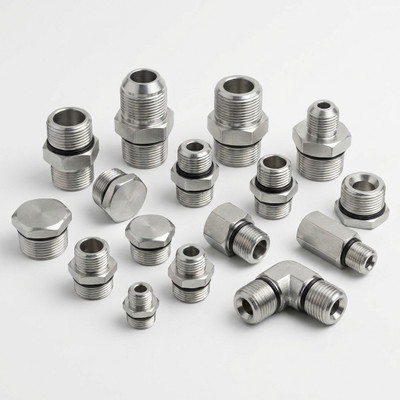
The fastest way to misidentify a hydraulic fitting is to begin with a thread that “looks about right.” Threads may only pull a joint together while an O-ring, flare, flat face, flange seal, or tapered interference contains the fluid. Two connections can have similar diameters and entirely different sealing mechanisms.
A reliable identification process begins at the seal, then uses thread and dimension evidence to confirm the family.
First find where fluid is supposed to stop
Clean the disconnected part using the approved procedure and inspect without damaging the surface. Look for an O-ring groove, flat face, conical seat, port chamfer, bonded washer location, tapered thread, or flange face.
Record male or female end, tube or hose size, body shape, material, and the connection on the opposite end. A straight adapter, adjustable elbow, swivel nut, or bulkhead can change assembly method even when the nominal thread is the same.
Do not use old sealant as proof of a tapered pipe thread. Sealant is sometimes applied incorrectly to flare or straight-thread connections and can hide the real seat.
ORB seals in a port chamfer
SAE O-ring boss uses a straight male thread with an O-ring near the shoulder. The O-ring compresses in the female port’s chamfer and spotface region. The threads retain the fitting but are not the primary fluid seal.
Straight connectors and plugs are commonly non-adjustable. Elbows and tees may use a locknut and backup washer so the body can be oriented before the O-ring is secured. Adjustable assembly requires the specified order and torque; forcing the body backward after tightening can damage the seal.
Confirm thread size, O-ring material and dimensions, port condition, and adjustable/non-adjustable design from the applicable standard or drawing.
ORFS seals across two flat faces
O-ring face seal has an O-ring groove in the male face. Tightening the swivel or tube nut compresses the O-ring against a flat mating face. The straight thread provides mechanical clamping.
Inspect the groove, O-ring, mating face, sleeve or braze area, and nut. A scratch across the seal path can leak even when threads are undamaged. O-ring compound must match fluid, temperature, pressure, and environmental exposure; one nitrile hardness is not universal.
ORFS is often selected where leakage control under vibration and cycling matters, but the exact assembly still needs verified ratings and installation.
Flange connections use a face seal and bolt load
Hydraulic split-flange connections commonly place an O-ring in the flange head face and use clamps with bolts to create load. Code, nominal size, bolt pattern, head dimensions, port face, O-ring, clamp, and fasteners all have to match.
Similar four-bolt patterns do not prove interchangeability. Do not identify Code 61, Code 62, or an OEM flange from bolt spacing alone. Use the controlled dimensions and component markings.
JIC and SAE 45-degree flares differ at the seat
JIC fittings use a 37-degree flare seat. SAE 45-degree flare connections use a different angle and are common in other fluid-service contexts. The straight thread is not the seal; mating metal seats contact when the nut is tightened.
Measure or gauge the seat angle and thread rather than judging the cone by eye. A 37-degree male can begin to connect with a 45-degree female yet produce a narrow, damaged contact band.
AN and JIC share a nominal 37-degree concept in many contexts, but material, thread class, dimensions, inspection, and application requirements can differ. Do not state that all AN and JIC parts are interchangeable without specific engineering evidence.
Tapered pipe threads seal along engagement
NPT and BSPT are tapered pipe-thread systems with different thread forms and dimensions. NPT uses a 60-degree thread form; BSP threads use a 55-degree Whitworth form. A near size may start but damage both components or leak.
Tapered joints require the sealant and engagement method specified for the equipment and fluid. Tape, paste, or anaerobic products have different contamination, temperature, chemical, and assembly effects. More tightening is not a cure for mismatched or worn threads.
Metric is a measurement system, not one seal style. Metric connections may be parallel or tapered and can use cones, O-rings, bonded washers, ferrules, or other seats. Diameter and pitch alone do not identify the complete connection.
Measure without rounding to the nominal name
Use clean calipers, a thread-pitch gauge, seat gauges, and reference charts for the suspected standard. Measure male major diameter or the specified female diameter at the correct location. For a taper, compare diameter at separated positions when the method calls for it.
Count pitch over several threads where access permits. Record the raw value before converting to threads per inch or millimeters per thread. Worn first threads, plating, paint, and burrs can distort a single measurement.
Match all evidence—seal, thread form, size, pitch, seat, and mating component—to a drawing or standard table. Do not average male and female diameters or force a nominal size from one dimension.
Finish with application requirements
After identification, confirm pressure-temperature rating, fluid and seal compatibility, tube or hose specification, material and finish, body geometry, assembly method, and service environment. The lowest-rated qualified component controls the connection.
Keep verified samples and measurements linked to part numbers and revisions. Separate similar thread families in inventory and quarantine an uncertain part rather than test-fitting it into an expensive port.
Popular fitting families become easier to identify when the seal is treated as the primary evidence. O-ring, face, flare, flange, and tapered-thread connections each leave a different geometric signature; the thread name should confirm that signature, not replace it.