
Select Quick Couplings by Connection Cycle, Media, and Safety Function
HGW Hydraulics on Jul 22nd 2021
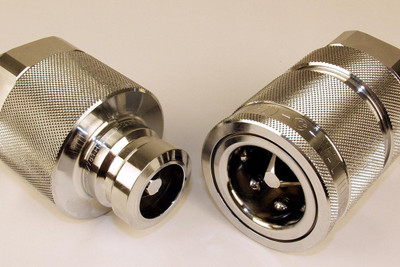
“Quick connect” describes a connection benefit, not one universal mechanism. A hydraulic quick-disconnect coupling normally joins a plug and socket for repeated connection cycles. A push-in tube fitting instead grips the outside of tubing with a collet or grab ring and seals it with an O-ring.
The two products can appear in similar searches, but they require different identification and risk checks.
Decide what must be disconnected
A service coupling is useful when an attachment, test line, tool or machine module must be removed without rebuilding the conductor. It may include valves that close one or both halves when separated. The valve arrangement affects spillage, air inclusion, pressure loss and how the circuit behaves while disconnected.
A push-in tube fitting is better described as a fast tube-termination method. The tube is cut square, inserted through the release element and seal, and seated against an internal stop. It is common in water, pneumatic and selected low-pressure fluid systems, but it is not automatically a hydraulic quick-disconnect.
Match the coupling to the operating sequence
Record how often the joint will be opened, whether the machine is shut down and depressurized first, and whether residual pressure can remain on either half. Some designs permit connection under defined pressure conditions; many do not. Never assume a coupling can be struck, forced or loosened to overcome trapped pressure.
Frequent cycles make dust, damaged noses, worn seals and incomplete locking more important. A sleeve that appears to move into place may still leave balls or latches partially engaged. Connect according to the product procedure, then perform the specified pull check and leakage inspection.
Evaluate pressure loss and heat at the restriction
Internal valves and small passages can create a pressure drop. Flow rate, fluid viscosity and coupling size determine whether that loss matters. A coupling selected only by thread size may restrict an attachment circuit, generate heat or slow an actuator.
Compare rated flow or pressure-drop data for the exact series. The coupling assembly is limited by its weakest half, seal, adapter and conductor, not by the catalog maximum of a visually similar model.
Keep service families separated
Water purification, beverage, vehicle air, medical equipment, factory air, mobile hydraulics and chemical transfer can all use fast connections. Their materials, cleanliness, certification, valve behavior and connection safeguards are different.
For potable water or food contact, verify the required certification and current product listing. For vehicle air-brake service, use components specifically authorized for that system. Medical or breathing applications require their own controls; a generic leak-free claim does not establish suitability.
Hydraulic equipment may require flat-face geometry to reduce contamination and spillage, a breakaway function, or a design that prevents cross-connection between circuits. Color alone is not positive identification unless the equipment procedure defines it.
Inspect both halves as one pair
Before connection, clean the faces without pushing dirt into an open circuit. Inspect dents, corrosion, displaced seals, worn locking features and evidence that a mismatched plug was forced into the socket. Cap disconnected halves with clean, compatible protection.
Mixing profiles can create partial engagement even when nominal body size is similar. Identify manufacturer series or a verified dimensional standard, body size, valve type, pressure and flow requirement, seal compound, material and end connection on both halves.
Prepare push-in tubing separately
Where the product is a reusable push-in tube fitting, confirm tube outside diameter, material, hardness and surface finish. Cut the tube square, remove damage without creating a sharp edge, mark insertion depth and push it fully to the stop. Side load, oval tube or a longitudinal scratch across the O-ring path can cause leakage.
Release the tube only by the intended collet action and only after the system is safe. Trim or replace a marked tube end as the product instructions require before reinsertion.
A useful quick connection reduces service time without making identification optional. Define the mechanism and disconnect sequence first, then select a qualified product for the actual media, pressure, temperature, flow and environment.