
Selecting Stainless Steel Ball Valves for Industrial Fluid Service
HGW Hydraulics on Aug 6th 2024
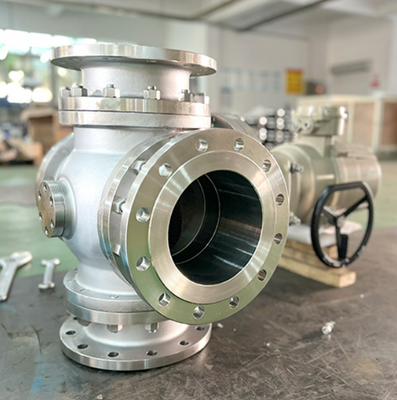
A ball valve controls flow by rotating a bored sphere between seats. When the bore aligns with the piping, the passage is open; a quarter turn places solid ball surface across the route and closes it. This compact action makes ball valves common for isolation and switching, but it does not make every stainless valve suitable for every industrial fluid.
Selection needs a full pressure-temperature-material definition and an understanding of how the valve will be operated, cleaned, and maintained.
Start with valve function and flow path
Two-way valves provide isolation. Three-way and multiport balls can divert, mix, or select routes according to their bore pattern. The required operating state and fail position should be shown on a simple flow diagram.
Full-port designs reduce bore restriction relative to reduced-port valves, but flange, end connection, seat support, and internal geometry still affect pressure drop. Slurries, solids, viscous fluids, and throttling can erode seats or trap material in the cavity.
Standard ball valves are primarily isolation devices. Partly open operation can concentrate velocity on the ball and seat. Use a characterized control-ball design when modulation is required.
Stainless grade follows corrosion conditions
304 stainless serves many compatible water, air, food-equipment, building, and industrial conditions. 316 stainless commonly offers improved resistance in chloride and chemical exposure because of molybdenum. More aggressive media can require higher alloys, linings, or a different valve material.
“Stainless” does not guarantee sanitary, sour-service, oxygen-service, fire-safe, or seawater suitability. Cast and wrought material specifications, heat treatment, traceability, and surface finish may be controlled by the application.
External atmosphere matters alongside the process fluid. Coastal spray, washdown, insulation, and galvanic contact can attack the body, stem, fasteners, and mounting hardware differently.
Seats, stem seals, and cavity behavior set limits
PTFE-family seats, reinforced polymers, PEEK, elastomers, and metal seats have different pressure, temperature, chemical, wear, and leakage behavior. The valve pressure-temperature chart reflects their combination with the body design.
Stem packing limits external leakage where the stem exits the body. Cycle frequency, side load, thermal movement, emissions requirements, and adjustment design affect service. A blowout-resistant stem or antistatic feature may be required by a particular standard.
Some valves trap fluid in the body cavity when closed. Thermal expansion can raise cavity pressure. Vented balls, relief arrangements, or operating procedures may be necessary for cryogenic, liquid, or blocked-in service.
End connections must match the piping system
Threaded NPT or BSP ends, welded sockets or butts, flanges, compression ends, and sanitary connections require different assembly and inspection. Verify nominal size, pressure class or schedule, weld procedure, gasket or seal, and mating standard.
Do not transfer thread sealant to a flange or sanitary face, and do not weld a valve without following heat-control and disassembly instructions. Misalignment can load the valve body and stem.
Manual and actuated valves need torque review
A handle provides visible quarter-turn operation. Locking, lockout, gear operation, or position indication may be required. Pneumatic and electric actuators must deliver adequate torque at the worst differential pressure and temperature with the specified safety margin.
Define fail-open, fail-closed, or fail-in-place behavior, air supply or voltage, duty cycle, enclosure, hazardous-area approval, limit switches, and control interface. Mounting dimensions alone do not prove actuator compatibility.
Match applications without copying generic promises
Stainless ball valves appear in many unrelated services: chemical dosing, municipal water, energy facilities, mineral processing, paper mills, hygienic production equipment, building cooling, and general plant utilities. Each area imposes different media, cleanliness, codes, and wear.
A slurry valve needs abrasion and cavity review. A food-contact valve needs hygienic design and validated cleaning. A steam valve needs a verified pressure-temperature rating and seat. An aggressive chemical requires exact compatibility data.
Plan inspection and replacement
Before service, isolate and depressurize the valve and drain hazardous or hot media under the site procedure. Inspect leakage, operating torque, stem packing, seats, corrosion, actuator alignment, and end connections. Life cannot be predicted as a fixed number of years without cycle, media, temperature, and maintenance data.
Specify size, bore, flow pattern, body and trim materials, seat and stem seals, pressure-temperature requirement, end standard, actuation, testing, and documentation. That complete definition selects a stainless ball valve for the process rather than assuming one alloy and quarter-turn handle can cover every industry.