
Select Stainless Hose Fittings by Hose Retention, Port Seal, and Alloy
Oct 3rd 2023
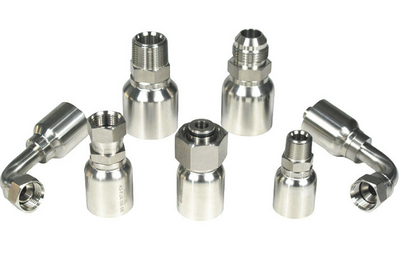
“Stainless hose fitting” describes material but not function. A buyer still needs to identify how the fitting grips the hose, how it seals to the equipment, which hose construction it is qualified to use, and what alloy and documentation the environment requires. Selecting alloy first can produce a corrosion-resistant part that does not fit the assembly.
Define the hose-side retention method
Permanent crimp fittings use a stem and ferrule deformed around the hose with controlled tooling. One-piece designs keep the stem and ferrule together for handling and assembly. Two-piece systems use separate components, which can support a broader set of configurations within a qualified product family.
Neither architecture has one universal pressure rating or reliability advantage. Hose type, dash size, stem, ferrule, crimp diameter, insertion depth, preparation, and manufacturer qualification establish the completed assembly. Permanent crimp components are generally not reused after removal.
Field-attachable or reusable fittings use a specified threaded or mechanical assembly process instead of a production crimp. They can be useful where approved for remote service, but the word reusable does not authorize unlimited installations or use on any braided hose. Inspect the socket, nipple, threads, hose end, and dimensional limits each time.
Barbed and push-on connections are intended for particular hose and retention systems. Some use clamps; some qualified push-on hose systems rely on designed interference. They should not be moved into a hydraulic pressure circuit from a generic low-pressure label. Verify pressure, temperature, fluid, pull-off resistance, and whether a clamp is required or prohibited.
Quick couplings, cam-and-groove fittings, sanitary ends, and other transfer connectors can also terminate hose. Each has its own pressure, spill, flow, seal, and connection controls and should not be grouped with a crimp fitting solely because both are stainless.
Specify the equipment-side seal independently
A hose fitting can terminate in JIC 37-degree flare, ORFS face seal, ORB stud, NPT, BSP, metric cone, flange, quick coupling, or another standard. Thread diameter alone does not identify these ends.
Record male or female form, size and pitch, flare or cone angle, taper or parallel geometry, O-ring or washer location, and installed orientation. NPT and BSPT tapered threads, BSPP face-sealing arrangements, JIC metal flares, and ORFS elastomeric faces require different assembly practices.
When an adapter is used between the hose end and machine, include it in pressure, corrosion, cleanliness, and routing review. Several stainless parts with incompatible seals do not create a valid connection.
Choose the stainless grade from the corrosion mechanism
304-family stainless can suit many general industrial environments. 316 and 316L include molybdenum, which often improves resistance to pitting in chloride exposure. Low-carbon grades can be important where welding and sensitization are concerns. Other stabilized or higher-alloy grades should be selected only from actual temperature, fabrication, chemical, and corrosion requirements.
No stainless grade is corrosion proof. Salt deposits, crevices, stagnant solution, cleaning chemicals, dissimilar metals, and embedded carbon-steel contamination can still initiate attack. Confirm the bore’s fluid exposure and the exterior environment separately.
Alloy grade does not determine fitting pressure by itself. Body geometry, manufacturing, hose retention, size, seal, and qualification control. Avoid unsupported tables that assign one pressure limit to all one-piece, two-piece, reusable, or barb fittings.
Include elastomers and hose materials in compatibility
An all-stainless body can still leak when the O-ring is incompatible with the fluid or temperature. Record elastomer compound for ORFS, ORB, quick coupling, and other sealed ends. PTFE hose, thermoplastic hose, rubber hydraulic hose, coolant hose, and metal hose require different stem, ferrule, and preparation systems.
Check both transported media and cleaning or flushing fluids. Steam, oxygen, refrigerant, food contact, pharmaceutical, chemical, and fire-related services can carry special regulatory or cleanliness requirements beyond general hydraulic compatibility.
Build an assembly process around traceable data
Use the current crimp or assembly instructions for the exact hose and fitting. Verify tooling calibration, die, insertion mark, crimp measurement, orientation, cleanliness, and visual condition. Skive only when the qualified system calls for it. Cap clean ends after assembly and protect sealing surfaces from damage.
Testing should follow the applicable hose program and application requirement. Working pressure, proof, burst, impulse, leakage, corrosion, vibration, and thermal-cycle tests answer different questions; one result cannot be used as proof of all performance. Keep lot, material, and test documentation at the level requested by the customer or design.
Inspect the failure mode that the stainless body cannot prevent
Service inspection includes hose abrasion, cracking, blistering, exposed reinforcement, kinks, coupling movement, leakage, seal damage, galling, corrosion, and loose connections. Stainless threads can gall when installation practices are unsuitable, while a hose can fail from heat or bend even when the fitting body remains perfect.
For procurement, describe hose construction and size, retention system, equipment-side connection, material grade, seal compound, pressure and temperature, media, orientation, environment, testing, cleanliness, and traceability. That sequence selects a functional hose assembly first and then gives it the stainless material system needed for the service.