
Turn STAMPED Hose Data into a Repeatable Hydraulic Assembly Specification
Oct 27th 2022
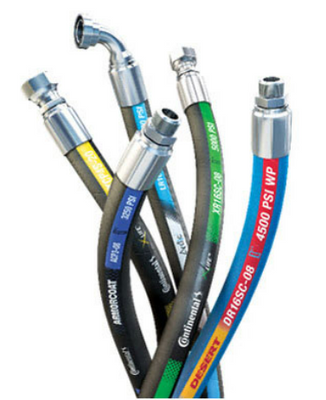
STAMPED is useful only when each letter produces information that another technician or supplier can verify. “Same as the old hose” is not a specification, and a photograph rarely shows pressure, fluid compatibility, temperature, or the internal condition of a failed assembly.
Use Size, Temperature, Application, Material, Pressure, Ends, and Delivery to collect the operating facts. Then connect those facts to a qualified hose, fitting, and assembly procedure rather than selecting seven features independently.
S: define flow size and installed geometry
Record hose inside diameter, not only outside diameter or a dash number copied from a worn layline. The bore must support required flow within the machine designer’s limits for velocity, pressure loss, heat, and response. A smaller hose can restrict flow; an unnecessarily large one adds fluid volume, weight, cost, and routing difficulty.
Finished length should be measured using the applicable points on the end fittings, with enough allowance for pressure movement and machine articulation. Include minimum bend radius, straight length near couplings, clamps, guards, abrasion points, and orientation between elbows. A correct catalog size can still fail when installed under tension or twist.
T: capture fluid and surrounding temperatures
State continuous and transient fluid temperature plus ambient extremes. Cold startup, engine compartments, exhaust proximity, radiant heat, outdoor sun, foundry exposure, and refrigerated operation can affect different surfaces of the hose.
Temperature capability depends on the hose compound, fluid, duration, fittings, and seals. Do not assume a sleeve upgrades a hose beyond its published operating range. If heat shielding is needed, specify its position and confirm that it does not trap damaging abrasion or conceal inspections.
A: describe what the assembly does all day
Application data covers the equipment, function, motion, duty cycle, routing, and consequences of failure. Note whether the line is stationary, flexes with a cylinder, travels over a pulley, sits on a reel, sees torsion, receives impulse cycles, or can be crushed by debris.
External exposures include abrasion, ozone, UV, salt, washdown, welding spatter, chemicals, hot surfaces, and worker line of sight. Requirements for flame resistance, static dissipation, pinhole containment, cleanliness, or special guarding belong here. The expected inspection access and replacement method are also part of the application.
M: name the media and every material it contacts
Provide the exact hydraulic fluid or transferred product, manufacturer and grade when available, concentration for water mixtures, and possible cleaning or flushing chemicals. “Oil” or “coolant” may be too broad for a reliable compatibility check.
Evaluate the inner tube, cover, reinforcement exposure, fitting base metal and coating, O-rings, backup rings, and any adhesive or sleeve. Outside contamination can attack the cover while the transported fluid affects the bore. Compatibility should be supported by the component manufacturer or responsible engineering authority.
P: record the real pressure envelope
Include normal operating pressure, relief setting, measured surges, impulse frequency, and vacuum or suction. Consider cold start, end-of-stroke, stalled tools, rapid valve changes, and attachment modes. Use instrumentation capable of seeing relevant transient events when the application warrants it.
The assembly working rating is controlled by its lowest-rated qualified part and any temperature derating. Burst pressure is not an operating target. A higher hose rating cannot compensate for an incompatible fitting, wrong crimp, damaged port, or routing below minimum bend radius.
E: identify each end completely
For both ends, document thread or flange standard, nominal size, pitch where needed, sealing geometry, male or female form, straight or elbow body, material, and orientation. JIC, ORFS, ORB, NPT, BSP, metric tube, and flange ends are not determined by approximate diameter alone.
Also confirm the coupling series is approved for the selected hose and assembly method. A swivel nut used for installation alignment is not necessarily a live swivel intended to rotate under pressure.
D: make delivery part of quality control
Specify required date and quantity, but also packaging, protective caps, cleanliness, labels, test records, and traceability. The delivered assembly should be checked for length, orientation, part identity, crimp or retention evidence, contamination, damage, and correct end protection before installation.
Keep the STAMPED record with the equipment or part number. Revision control matters when a port changes, a hose family is replaced, or routing is improved. For recurring work, separate common stocked assemblies from low-frequency configurations and define how an urgent substitution is approved.
Close the loop with the removed hose
When a hose is replaced, record where it failed and what the machine was doing. Abrasion, heat hardening, chemical swelling, a pulled coupling, bend damage, corrosion, and leakage at a sealing face point to different corrective actions. Installing the same part without reviewing the evidence can preserve the original cause.
A complete STAMPED sheet therefore supports selection, assembly, purchasing, installation, and later diagnosis. Its value is not the acronym itself; it is the repeatable set of facts that lets each participant produce and verify the same safe hydraulic assembly.