
Qualify a Multi-Purpose Steel-Braid Hose Before Consolidating Inventory
Feb 1st 2023
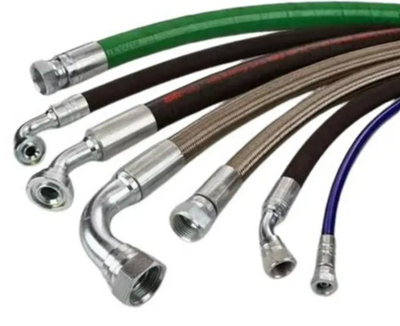
A flexible steel-braid hose can cover several hydraulic applications, but no hose should replace a warehouse full of products on a marketing claim alone. Consolidation is an engineering and inventory decision made size by size, circuit by circuit, and with the finished hose-end system included.
Define the candidate from its current data sheet
Record the manufacturer, hose family, date or revision of technical data, dash size, inside and outside diameter, working pressure, minimum burst requirement, bend radius, temperature limits, compatible fluids, cover, reinforcement, and applicable standards. A family can have different ratings across sizes, so one strong dash size does not establish the whole range.
Terms such as compact, ultra-flexible, tough cover, and cross-functional describe desired features but are not acceptance values. Ask for the actual dimensions, qualification basis, impulse conditions, abrasion method, and fitting compatibility needed for the applications being considered.
Compare standards without assuming equivalence
SAE 100R2, 100R16, and 100R17 describe different hose categories. A product may be designed to meet more than one performance requirement, yet the claim has to be verified for the exact size and construction. Matching an SAE designation does not prove identical bend radius, cover performance, temperature range, impulse behavior, or coupling system between two products.
Create a cross-reference matrix for each existing hose. Mark pressure, temperature, fluid, size, routing, duty, external exposure, and required approval. A candidate should replace an incumbent only where every controlling requirement is met.
Test the installed geometry
Steel braid can offer a useful balance between pressure capacity and flexibility. A compact construction may route through restricted equipment more easily than a larger hose, but minimum bend radius is only one measurement. Check straight length near the coupling, bend direction, torsion, clamp spacing, movement, cover clearance, and change in length under pressure.
Route a sample on representative machines before broad conversion. A tighter bend can reduce assembly length in some layouts; in others, the port locations and movement still require slack. Do not shorten every assembly from a general flexibility claim.
Qualify the hose and fitting as one system
Confirm the approved stem and ferrule series, crimp specification, insertion depth, skive requirement if any, tooling, die, inspection method, and pressure rating for the completed assembly. Compatibility with an adjustable crimper does not mean that any die setting or reusable fitting is acceptable.
Build and inspect sample assemblies under the responsible quality process. Include orientation, cleanliness, labeling, and traceability. Field technicians need the current crimp chart and a clear stop rule when a hose or fitting lot does not match the qualified system.
Measure whether consolidation actually helps
Fewer hose families may reduce bin space, training complexity, picking errors, and emergency substitutions. It may also concentrate supply risk, require new fittings or tooling, and leave higher-cost hose in low-demand applications. Compare annual usage, stocking depth, shelf controls, replenishment time, assembly labor, freight, and field performance.
Begin with a defined set of circuits and retain the former specification until the replacement is approved. Review failures by cause rather than crediting every improvement to the new hose. A multi-purpose steel-braid family earns a broader role through documented fit and service results, not through an unsupported promise that one construction replaces every other hose.