
Stainless Hose End Families for Corrosive Hydraulic and Fluid Service
Jan 19th 2023
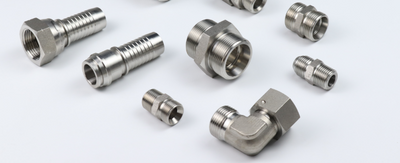
Stainless steel hose ends are selected when the fluid or surrounding environment makes ordinary plated steel difficult to maintain. The alloy can improve corrosion resistance, but it does not determine connection type or hose compatibility. A stainless JIC fitting still seals at a 37-degree flare; stainless ORFS still uses a face O-ring; a stainless crimp stem still requires the approved hose and ferrule.
Selection therefore has two layers: choose the connection family and hose-attachment method, then confirm that the stainless grade and seals suit the environment.
Corrosion service must be described specifically
Salt spray, washdown chemicals, process media, humidity, and high temperature affect stainless in different ways. 316 often provides better resistance to chloride pitting than 304, but neither grade is immune to every concentration, temperature, or crevice condition.
Stainless can also gall during assembly, become contaminated by carbon-steel tooling, or suffer corrosion at damaged and stagnant areas. Specify alloy, surface condition, passivation or cleaning where required, and compatible O-ring material.
Avoid family-wide pressure and temperature promises. Ratings depend on size, shape, wall, fitting design, hose, seal, and manufacturer data.
ORFS and ORB place O-rings in different locations
ORFS uses an O-ring in the flat face of the male fitting. The mating female face clamps against it. The straight thread supplies load but is not the primary seal. Inspect the face and groove and protect the exposed O-ring from cuts.
ORB uses a straight male thread with an O-ring that seals in a prepared port. Adjustable elbows add a backup washer and locknut arrangement so orientation can be set without relying on thread position alone.
Both families can support demanding hydraulic service when the exact component is rated for it. Neither should be chosen only because an O-ring is assumed to outperform all metal seats.
JIC uses a metal 37-degree flare seat
JIC fittings use straight threads to clamp matching 37-degree flare surfaces. Stainless versions are common where corrosion resistance and broad adapter availability are useful. Seat scratches, over-tightening, and misalignment can still produce leaks.
AN, JIS, and other visually similar systems require separate identification. Thread and seat angle must both match.
Crimp ends must match hose, stem, and ferrule
A stainless crimp end may be one-piece or use a separate stainless ferrule. Product-series names are manufacturer-specific and should not be copied across brands. Use the current crimp table for the exact hose construction, fitting, ferrule, die, and finished diameter.
Skive and no-skive requirements belong to that combination. Stainless material does not change an unapproved mixed assembly into a qualified one.
Barbs and push-on ends serve selected lower-pressure systems
Stainless barbs can connect compatible hose using the specified clamp, sleeve, or retention method. Push-on systems use hose and barb geometry designed to assemble together, often without a clamp when the manufacturer permits it.
These ends are useful in water, air, return, lubrication, and process services covered by their ratings. They are not generic substitutes for high-pressure hydraulic crimp ends.
Finish the choice with STAMP data
Record Size, Temperature, Application, Material or media, and Pressure, then add end connection, attachment method, movement, cleanliness, and external exposure. Check the lowest-rated part across hose, fitting, adapter, seal, and port.
Stainless solves a material problem; it does not solve identification. When alloy and connection architecture are specified separately, a corrosion-resistant hose end can be selected without hiding the seal or attachment requirements behind the metal name.