
Universal Joints on Hydraulic Equipment: Torque Transfer, Wear, and Replacement
HGW Hydraulics on May 18th 2021
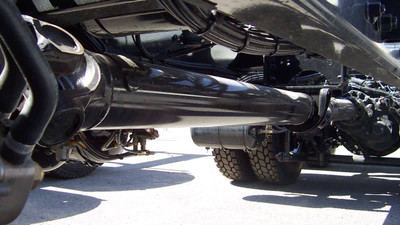
A universal joint belongs to the mechanical power path of a machine. It transfers rotation between shafts that meet at an angle, while the hydraulic circuit carries fluid through pumps, valves, hoses, fittings, cylinders, and motors. The two systems often work beside each other, but they do different jobs. Recognizing that distinction is the starting point for diagnosing a pump drive, power-takeoff assembly, mobile driveline, steering shaft, or rotating attachment.
On hydraulic-powered equipment, a U joint is useful whenever the driving and driven shafts cannot stay on one perfectly straight axis. It gives the driveline controlled angular movement while continuing to transmit torque. It does not correct every alignment problem, and it should not be expected to compensate for an angle, speed, or load outside the machine design.
Follow the power path before blaming the hydraulic circuit
Consider a truck with a power takeoff driving a hydraulic pump. The engine and PTO supply mechanical rotation, the shaft and U joint carry that rotation to the pump, and the pump converts it into hydraulic flow. If the joint develops excessive play or begins binding, the pump may receive irregular input even though the oil, hoses, and fittings are still in acceptable condition.
That relationship can make a driveline fault look like a hydraulic problem. Vibration at the pump, changing pump speed, unusual noise, leaking shaft seals, or repeated coupling damage should prompt inspection of both sides of the system. Pressure and flow data describe the hydraulic side; shaft angle, runout, phasing, support bearings, and joint condition describe the mechanical side.
How a universal joint carries torque through an angle
A common U joint has two yokes connected by a cross-shaped center member. Four trunnions on the cross run inside bearing caps. Needle bearings in the caps let the yokes move relative to one another as the shafts rotate, while retainers keep the caps seated in the yokes.
This geometry permits angular misalignment, but the output motion is not perfectly uniform when a single joint operates at an angle. The greater the working angle, the greater the cyclic speed variation and bearing load can become. Drivelines often use a second joint and correct phasing to manage that variation. The equipment service information, rather than appearance alone, should determine the acceptable angle and arrangement.
The cross, caps, bearings, seals, yokes, lubricant, and retaining hardware function as one assembly. A dry or brinelled bearing cap can restrict movement on one trunnion and overload the others. A damaged retainer can let a cap move. A worn yoke bore can prevent a new joint from being held correctly even when the replacement cross dimensions are right.
Where U joints appear on hydraulic-powered machines
Mobile and industrial equipment can use universal joints in several different mechanical locations:
- A PTO shaft between a transmission output and a hydraulic pump.
- A vehicle driveline that powers a machine carrying hydraulic implements.
- A steering shaft that must pass around other components.
- An agricultural or construction attachment with a changing operating angle.
- A rotating pump or accessory drive where the shafts have a designed offset.
The application controls what matters most. A compact steering shaft may be governed by packaging and articulation. A PTO pump drive may be sensitive to continuous speed, support-bearing alignment, and torsional vibration. A heavy mobile driveline may see shock loading, contamination, suspension travel, and frequent reversing. These are all U-joint applications, but they do not call for the same component.
Operating angle, phasing, and support determine service life
Installing a stronger-looking joint will not solve an incorrect driveline layout. The shaft angle must remain within the equipment limits throughout its full movement, not only while the machine is parked. Yokes must be phased as specified, and connected shafts need adequate support so the joint is not carrying loads intended for a bearing.
Speed and torque must also be considered together. A joint that tolerates a high static torque may not be suitable for continuous rotation at the required speed and angle. Shock load, starts and stops, duty cycle, lubrication interval, temperature, water, abrasive dust, and chemical exposure can all change the selection or maintenance requirement.
On articulated equipment, inspect the joint through the actual range of motion. On a PTO-driven pump, check that the shaft is not being pushed or pulled axially as the frame moves. On an attachment, confirm that guards, hoses, and nearby structure cannot contact the rotating assembly.
Wear signs and the failure path
Early U-joint problems often appear as a dry squeak, a clunk when direction changes, vibration that varies with speed, rust-colored powder near a cap, lubricant loss, heat, or measurable movement between the cross and yoke. Binding can be just as serious as looseness. A joint that will not articulate freely can transmit side load into the pump shaft, gearbox, or adjacent support bearing.
Continued operation can enlarge yoke bores, damage retainers, overload shafts and seals, or allow the cross to fracture. The result may be loss of mechanical power to the hydraulic pump or uncontrolled movement of a broken shaft. Inspection should therefore be performed with the machine secured, stored energy released, attachments supported, and the driveline prevented from rotating according to the equipment procedure.
What to record for an accurate replacement
A replacement should be identified from dimensions and service requirements, not from a photograph alone. Record the bearing-cap diameter, cross width or span, yoke style, retaining method, lubrication arrangement, and any identification on the original component. Also document the shaft speed, transmitted torque, normal and maximum operating angles, duty cycle, and exposure to dirt, water, or washdown.
Inspect the surrounding parts before installing the new joint. A distorted yoke, damaged snap-ring groove, worn slip section, bent shaft, loose support bearing, or incorrect working angle can quickly damage the replacement. After assembly, verify free articulation, correct retainer seating, specified lubrication, shaft phasing, guarding, and clearance through the machine's movement.
Treat the joint and hydraulic drive as connected systems
A universal joint is not a hydraulic fitting, yet its condition can directly affect equipment that depends on hydraulic power. Reliable service comes from checking the entire energy path: the mechanical drive into the pump, the hydraulic circuit after the pump, and the structure supporting both. That approach separates a true fluid-power problem from a driveline problem and gives the replacement joint a better chance of reaching its intended service life.