HGW Resources

HGW Blog

Practical guides for identifying hydraulic fittings, comparing connection styles, checking applications, reviewing materials, and finding relevant HGW product categories.

Maintenance

Match Hydraulic Hose Protection to Abrasion, Heat, Bend, and Line-of-Sight Risk

HGW Hydraulics on Feb 29th 2024

Hose protection should address a known external hazard without hiding damage, trapping heat, restricting movement, or forcing the assembly below minimum bend radius. No sleeve or guard upgrades an incorrectly rated hose or repairs an assembly whose reinforcement, cover, or coupling is already damaged. Map the hazard along the hose route Observe the equipment through its full motion. Mark rub point

Maintenance

Build Hydraulic Maintenance Checklists Around Stored-Energy Control

HGW Hydraulics on Dec 21st 2023

A hydraulic maintenance checklist is effective only if it controls the energy that can move equipment or release fluid. Checking boxes after a fitting has been loosened is too late. The procedure must identify pressure, gravity, springs, accumulators, heat, electrical power, and external loads before work begins. Define the machine-specific safe state Follow the employer’s energy-control program a
Maintenance

Decide Hydraulic Fitting Reuse from Component Function and Damage Evidence

HGW Hydraulics on Oct 17th 2023

“Can this fitting be reused?” has no safe yes-or-no answer at the connection-family level. A detachable adapter body, a tube nut, a cutting ring and a crimped hose stem perform different functions and have different remake rules. Reuse requires product authorization and evidence that the component still meets its purpose. Classify the part before inspecting it A threaded adapter or removable ORFS,
Maintenance

Hydraulic Hose Bend Radius: Why Installation Radius Matters

Apr 13th 2023

Hydraulic hose installations often have to route around pumps, coolers, filters, cylinders, actuators, and moving machine parts. In those layouts, bend radius is not a cosmetic detail. It directly affects hose life and system safety. If a hose is bent tighter than its minimum bend radius, the reinforcement and tube can be damaged even before the system is put into full service. What Minimum Bend R
Maintenance

What a Hydraulic Hose Crimp Specification Controls

Jan 5th 2023

A crimp specification is the assembly recipe that connects one hose construction to one fitting system. It does more than provide a finished outside diameter. It identifies compatible parts, dies or machine settings, insertion and preparation requirements, measurement location, and acceptance tolerance. Ignoring any of those fields can produce an assembly that looks finished but does not develop t
Maintenance

Set Hydraulic Hose Pressure Margin Without Buying the Wrong Construction

Sep 15th 2022

A higher pressure number does not automatically produce a safer hydraulic hose assembly. Safety comes from matching the verified pressure envelope and every other service condition to a qualified hose-and-fitting system. Selecting the highest available class can add stiffness, cost, routing problems, tooling requirements, and slow-moving inventory while leaving the real failure mechanism untouched
Maintenance

Control Static Charge Across the Entire Industrial Hose Transfer Path

Sep 7th 2022

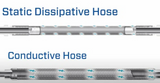
Static control in a hose operation cannot be assigned to the hose alone. Charge can develop during fluid transfer and then accumulate on hose reinforcement, couplings, containers, vehicles, or isolated equipment. The hazard becomes serious when a discharge can occur in an atmosphere containing flammable vapor, gas, mist, or combustible dust. A facility should evaluate the entire transfer path unde
Maintenance

Read Hydraulic Adapter Corrosion as Evidence, Not Just Surface Rust

Aug 17th 2022

Corrosion on a hydraulic adapter is evidence about the environment, material, installation, and maintenance history. A useful inspection does more than note that the fitting looks rusty. It identifies where attack began, whether a sealing or pressure-carrying surface is affected, and what must change before the replacement is installed. Map the location before judging severity Photograph the fitti
Maintenance

Manage Hydraulic Hose Temperature at the Tube, Cover, and Coupling

Jul 27th 2022

A hydraulic hose experiences temperature from both sides. Fluid heats the inner tube and coupling interface, while engines, exhaust, sunlight, weather and nearby process equipment affect the cover. The two temperatures can be different at the same moment. Hose selection and diagnosis should record both instead of relying on one reservoir reading. Compare continuous and intermittent limits Hose dat
Maintenance

Stop a Four-Bolt Flange Mismatch Before Any Hole Is Modified

HGW Hydraulics on May 4th 2022

If a four-bolt flange does not align with a port, the correct response is to stop. Filing holes, substituting bolts, thinning a head, or forcing clamps changes a pressure boundary without engineering verification. Code 61 and Code 62 are different systems SAE Code 61 and Code 62 flange patterns can appear close, but bolt spacing, flange head dimensions, clamps, fasteners, O-ring geometry, and rati