HGW Resources

HGW Blog

Practical guides for identifying hydraulic fittings, comparing connection styles, checking applications, reviewing materials, and finding relevant HGW product categories.

Connection Types

Identify French GAZ 24-Degree Connections by Seat, Lip, and Thread

HGW Hydraulics on Feb 3rd 2022

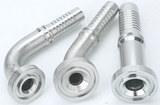
The French GAZ 24-degree equipment connection appears on selected imported hydrostatic and mobile hydraulic components. Shops sometimes group it with hydraulic flanges, yet its sealing face and fine metric retention thread require their own identification. The important evidence is the 24-degree mating geometry and projecting lip—not the equipment's country alone. Inspect the face before meas
Connection Types

Distinguish Code 61, Code 62, and OEM Four-Bolt Flange Patterns

HGW Hydraulics on Jan 25th 2022

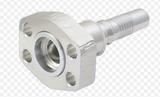
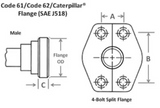
Code 61 and Code 62 are compact four-bolt hydraulic flange families used at pumps, motors, valves and large conductors. Both compress an O-ring between a flanged head and a flat port face, but their patterns and product ratings must not be blended. OEM variants can look even closer, so identification requires more than counting four holes. Let the standard and size define the series SAE J518 and c
Connection Types

Separate BSPP, BSPT, NPT, and NPTF by Thread Form and Seal

HGW Hydraulics on Jan 19th 2022

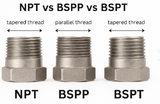
BSP and NPT parts can share a nominal pipe-size name and still have different diameter, pitch, thread angle, taper, and seal. A near-match that turns several times is not evidence of compatibility. BSPP needs a separate sealing feature BSPP uses a 55-degree Whitworth parallel thread. The thread usually retains the joint while a 60-degree cone, bonded washer, O-ring, copper washer, or another defin
Fitting Guides

Reading Hydraulic Hose Markings and Building the Correct Ferrule Connection

HGW Hydraulics on Jan 11th 2022

Color on a hydraulic drawing, printing on a hose cover, and paint or labels used in a shop do not mean the same thing. Drawing colors help an engineer follow circuit function. A hose layline identifies the product and its ratings. A maintenance color may identify a machine circuit. None of those colors, by themselves, tells a technician which stem, ferrule, crimp diameter, or skive process belongs
Connection Types

Four-Bolt Hydraulic Flanges: Load Distribution, Seal Setup, and Installation Errors

HGW Hydraulics on Jan 6th 2022

Four-bolt hydraulic flanges solve a packaging and load problem that becomes more difficult with large threaded connections. Instead of tightening one large fitting with high torque, the flange clamp transfers load through four smaller bolts around a sealed port. This can make hose-to-port and tube-to-component connections easier to assemble in confined mobile and industrial equipment. The arrangem
Materials

Choose Pneumatic Tube and Hose Materials from Motion, Media, and Environment

HGW Hydraulics on Dec 29th 2021

Pneumatic conductors carry compressed air between preparation equipment, valves, cylinders, grippers and tools. Material selection affects not only pressure capacity but also how the line bends, grips in a fitting, resists condensate and survives the machine environment. The same polymer name can cover multiple grades and constructions, so final limits must come from the exact tube or hose datashe
Fitting Guides

Matching Hydraulic Hose, Tube, and Fittings Across One Fluid System

HGW Hydraulics on Dec 23rd 2021

A hydraulic circuit can contain flexible hose, rigid tube, adapters, valves, pumps, cylinders, filters, sensors, and reservoirs. Each item may be correctly specified on its own and the finished line can still be wrong if the materials, ratings, sealing styles, or installed motion do not work together. Compatibility therefore has to be judged across the complete fluid path, not at the one fitting b
Fitting Guides

Choose Braided or Spiral Hose from the Machine Duty Cycle

HGW Hydraulics on Dec 14th 2021

Braided and spiral hose should be selected from the machine’s pressure-time history and route, not from a rule that braid is flexible and spiral is strong. The same reinforcement category includes many constructions, sizes, pressure classes, impulse ratings, and bend limits. A duty-cycle review reveals whether pressure fatigue, articulation, temperature, or packaging is the controlling problem. Ca
Connection Types

Do Not Confuse ASME Pipe Flanges with Hydraulic Four-Bolt Flanges

HGW Hydraulics on Dec 8th 2021

“DIN flange versus ANSI flange” sounds like a simple metric-versus-inch choice, but it can mix unrelated products. DIN and ANSI are standards organizations or historical labels, not complete connection descriptions. A plant pipe flange and a compact hydraulic four-bolt flange do not become alternatives merely because both use bolts. The first task is to identify the governing standard and system f
Connection Types

ORFS Connects Two Line Ends; ORB Terminates at a Component Port

HGW Hydraulics on Nov 30th 2021

ORFS and ORB both use straight threads and an O-ring, but they solve different interface problems. ORFS joins two line ends across flat faces. ORB installs a fitting into a machined component port. Confusing them can put the correct thread next to the wrong seal. ORFS seals at the end face An ORFS male has an O-ring groove in its flat face. The female swivel or tube end presents a flat mating surf