HGW Resources

HGW Blog

Practical guides for identifying hydraulic fittings, comparing connection styles, checking applications, reviewing materials, and finding relevant HGW product categories.

Maintenance

Weld Purpose-Designed Hydraulic Connections under a Qualified Procedure

HGW Hydraulics on Jun 4th 2025

Welding a hydraulic connection is a pressure-boundary fabrication task. It should use a fitting designed with a weld end, an approved joint drawing and a qualified procedure—not a general instruction to weld any leaking threaded or hose fitting. The safe workflow begins by deciding whether welding is permitted at all. Reject repairs that heat an assembled hose or unknown fitting Do not weld a crim
Applications

Tractor Hydraulic Connections from Attachment Couplers to Permanent Hose Ends

HGW Hydraulics on May 29th 2025

Tractors power loaders, balers, plows, mowers, planters, sprayers, backhoes, and other attachments through hydraulic circuits. The connection used at an attachment breakaway point has a different job from the permanent hose ends routed along a boom or implement. Quick couplers support frequent connection. JIC and ORFS commonly create fixed serviceable joints elsewhere in the line. Identifying thos
Maintenance

Deciding Between a Hydraulic Oil Change, Filter Service, and Full-System Flush

HGW Hydraulics on May 13th 2025

Hydraulic oil should not be replaced only because a calendar date arrived or its color looks darker. It also should not remain in service after analysis shows loss of useful properties or contamination beyond the system’s control. A condition-based decision considers fluid chemistry, particles, water, temperature history, equipment condition, and the failure event. The required action may be filte
Applications

Where Hydraulic Power Fits in Eight Manufacturing Machines

HGW Hydraulics on May 7th 2025

Hydraulic power converts mechanical input at a pump into controlled fluid pressure and flow, then into force or torque at a cylinder or motor. Manufacturing equipment uses that capability where high force, compact actuators, load holding, or controlled motion justify a fluid-power system. Hoses, tubes, manifolds, fittings, filters, reservoirs, valves, sensors, accumulators, and cooling all support
Materials

Galvanized Malleable Iron Pipe Fittings: Where Zinc Coating Helps and Where It Does Not

HGW Hydraulics on Apr 29th 2025

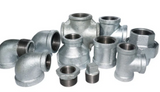
Galvanized malleable iron fittings combine an annealed iron casting with a zinc coating. The casting process provides threaded elbows, tees, unions, reducers, caps, bushings, flanges, and branches in compact shapes. Galvanizing delays corrosion of the iron surface in suitable atmospheres and fluid services. The material is common, but it is not a universal hydraulic or process connection. Pressure
Applications

Specifying Instrumentation Connections for Medical and Life Science Equipment

HGW Hydraulics on Apr 24th 2025

Medical and life science equipment can contain analytical instruments, gas and liquid controls, laboratory skids, utilities, diagnostic systems, bioprocess equipment, and manufacturing machinery. Their connections range from general pneumatic or hydraulic utilities to clean process paths and regulated device components. One fitting catalog cannot define every requirement. Selection starts by class
Applications

Hydraulic Connections Around Food Filling, Mixing, and Packaging Equipment

HGW Hydraulics on Apr 9th 2025

Food and beverage plants use hydraulics to clamp, lift, position, press, convey, meter, and move packaging equipment. The hydraulic circuit may sit beside mixers, fillers, cappers, labelers, conveyors, palletizers, and cleaning systems without contacting the product directly. That distinction matters. A stainless hydraulic fitting is not automatically a hygienic product-contact fitting. The equipm
Connection Types

BSP Fitting Identification for Global Hydraulic Equipment

HGW Hydraulics on Apr 3rd 2025

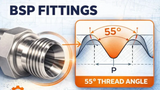
BSP fittings appear on European, Asian, Australian, African, Middle Eastern, and globally supplied machinery. The family includes parallel and tapered threads, several sealing arrangements, many body shapes, and materials ranging from carbon steel and stainless to brass and polymers. A useful identification process narrows that variety in a fixed order: equipment context, male/female end, parallel
Connection Types

Reading G, R, Rc, and Rp Pipe Thread Callouts Correctly

HGW Hydraulics on Mar 25th 2025

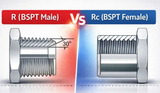
Terms such as BSPP and BSPT are useful shop language, but engineering drawings often use G, R, Rc, and Rp. Those letters identify not only parallel or tapered geometry but also which standard and pressure-joint concept applies. The key distinction is that ISO 228-1 G threads are fastening threads whose pressure seal occurs outside the thread. ISO 7-1 R-family threads are intended for pressure-tigh
Connection Types

Why the JIC 37-Degree Flare Still Anchors Hydraulic Repair Inventories

HGW Hydraulics on Mar 12th 2025

JIC fittings remain common because a large population of North American mobile and industrial equipment was designed around the 37-degree flare. That installed base influences hose ends, adapter drawers, maintenance skills, bills of material and emergency replacement decisions. Longevity is not proof that JIC is best for every new circuit. It means the connection has a mature support system and mu