HGW Resources

HGW Blog

Practical guides for identifying hydraulic fittings, comparing connection styles, checking applications, reviewing materials, and finding relevant HGW product categories.

Connection Types

Assembling BSP Parallel and BSP Tapered Connections by Seal Location

HGW Hydraulics on Mar 4th 2025

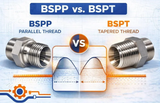
BSP parallel and BSP tapered threads share a 55-degree Whitworth profile, but their finished joints contain fluid in different places. A BSPP or G-thread hydraulic port normally seals at a shoulder, washer, O-ring, cone, or other defined face. A BSPT or R-family tapered joint seals through controlled thread engagement under the specified sealing practice. Assembly should follow that fluid boundary
Connection Types

Why a BSP Thread Name Cannot Supply an Adapter Pressure Rating

HGW Hydraulics on Feb 27th 2025

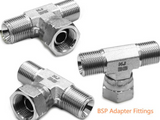
BSP describes thread geometry, not a universal pressure class. A G-thread bonded-seal adapter, an R-thread steel elbow, a plastic BSP fitting, and a bronze valve can share a nominal thread family while having very different allowable service conditions. Pressure selection therefore starts with the exact component and its governing product data. Thread standard, size, body geometry, material, manuf
Materials

Stainless Hydraulic Hose Ends: Corrosion Benefits and Assembly Limits

HGW Hydraulics on Feb 19th 2025

Stainless steel hose ends are useful where carbon-steel fittings would corrode from the conveyed fluid, washdown, chemicals, salt, humidity, or outdoor exposure. Their corrosion resistance can reduce coating loss and rust contamination, but it does not make the hose assembly unlimited in pressure, temperature, or service life. The fitting must belong to a matched assembly: exact hose construction,
Connection Types

BSPP Class A and B Apply to External G Threads—not Two Male/Female Grades

HGW Hydraulics on Feb 13th 2025

ISO 228-1 BSPP threads are parallel 55-degree Whitworth-form threads intended for mechanical assembly. When a pressure-tight connection is required, a washer, O-ring, gasket, cone, or other defined surface outside the thread creates the seal. The tolerance notation is often described incorrectly. Under ISO 228-1, Class A and Class B are the two pitch-diameter tolerance classes for external G threa
Materials

Use EPDM Only with Fluids Confirmed by Compatibility Data

HGW Hydraulics on Feb 4th 2025

EPDM elastomers are generally unsuitable for petroleum-based hydraulic oils because hydrocarbon exposure can cause swelling, softening and loss of mechanical properties. That is a material-compatibility failure, not a fitting-tightness problem. The final decision still requires data for the exact EPDM compound and fluid formulation rather than a rule based only on color or trade name. Match the co
Applications

Hydraulic Power on Drilling and Production Equipment: Fluid, Lines, and Maintenance

HGW Hydraulics on Jan 29th 2025

Hydraulic systems operate clamps, positioning devices, winches, top-drive or support functions, control valves, handling equipment, and other mechanisms across drilling and production sites. Their value is compact power transmission and controllable motion. Their risk is that high-pressure energy and contamination can move through a distributed network of lines and connections. Reliable service de
Applications

Specify Heavy-Lift Hydraulic Hose for Motion, Load, and Electrical Exposure

HGW Hydraulics on Jan 21st 2025

Hydraulic hose on lifting and material-handling equipment is both a pressure conductor and a moving machine component. Selection must cover the full duty: load-induced pressure, transients, articulation, ambient hazards, fluid, temperature, abrasion, electrical exposure and the way a failure could affect people or a suspended load. A hose family name is not enough. The exact hose, ends and assembl
Applications

Connection Checklist for Upstream Oil and Gas Hydraulic and Instrument Lines

HGW Hydraulics on Jan 16th 2025

Upstream oil and gas equipment uses hydraulic and instrumentation connections on drilling rigs, wellheads, control panels, production skids, chemical injection, safety systems, and mobile support equipment. The operating environments differ, but they share a need for correct service identification before a fitting is selected. A connection that carries clean hydraulic oil inside a panel is not spe
Applications

Wellhead Control Panel Connections: From Hydraulic Supply to Safe Valve Actuation

HGW Hydraulics on Jan 16th 2025

A wellhead control panel sends controlled hydraulic or pneumatic energy to surface and subsurface safety functions. Its tubes, fittings, valves, gauges, reservoirs, pumps, accumulators, and logic elements must preserve pressure and signal integrity while allowing safe isolation and testing. Selecting a fitting from thread size alone misses the panel’s real purpose. Each connection belongs to a cir
Applications

Protecting Hydraulic Connections on Mining Excavators, Loaders, and Water Equipment

HGW Hydraulics on Jan 8th 2025

Mining equipment combines high loads with dust, rock impact, vibration, weather, heat, wash water, and limited maintenance windows. A hydraulic hose that works on a clean power unit can fail quickly when it rubs a boom, is crushed by debris, or is pulled tight through articulation. Connection reliability begins with the machine’s motion and exposure. The fitting, hose, guard, clamp, and route shou