HGW Resources

HGW Blog

Practical guides for identifying hydraulic fittings, comparing connection styles, checking applications, reviewing materials, and finding relevant HGW product categories.

Materials

Brass or Stainless Fittings: Select by Fluid, Environment, Load, and Connection

HGW Hydraulics on Jul 18th 2024

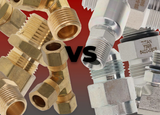
Brass and stainless steel can both resist the red rust associated with unprotected carbon steel, but they do so through different alloy systems. Brass is copper-zinc based; stainless relies on a chromium-rich passive film. Neither material is one fixed composition, and neither is correct for every fluid connection. Selection begins with the exact alloy and product standard, then considers media, e
Materials

Design Stainless Saltwater Fittings against Pitting and Crevice Attack

HGW Hydraulics on Jul 10th 2024

Saltwater is not a mild environment for stainless steel. Chlorides can break down a passive surface locally and produce pitting or crevice attack even when most of the part remains bright. Stainless often outperforms unprotected carbon steel, but grade, geometry and maintenance determine whether that advantage is adequate. Understand what the passive film can and cannot do Chromium in stainless st
Materials

Allocate Stainless and Coated Steel Fittings by Corrosion Zone

HGW Hydraulics on Jul 4th 2024

A machine does not experience one environment. A fitting under a closed hood may remain dry while another on the same circuit sees road salt, washdown, fertilizer, mine water, or marine spray. Mapping those corrosion zones allows stainless to be used where it solves a defined problem and coated carbon steel where it remains practical. Divide the equipment by exposure Mark continuous wetting, salt
Fitting Guides

Specify Brass Push-On Hose Fittings as a Qualified Hose System

HGW Hydraulics on Jun 25th 2024

A brass push-on hose fitting can provide a fast connection without a production crimp, but only within a matched hose-and-fitting system. The fact that a barb enters the hose does not authorize clamp-free service or establish pressure capability. Identify the dedicated hose and retention design Record hose manufacturer and family, inside diameter, wall, reinforcement, temperature, fluid, pressure,
Maintenance

Control O-Ring Shelf Life Through Packaging, Cure Data, and Inspection

HGW Hydraulics on Jun 19th 2024

An unused fitting can become unserviceable while the metal body still looks new because its installed O-ring was stored without identity or protection. Shelf-life control begins with compound, cure or manufacturing data, packaging, and environment. It ends with an inspection and application check before the seal is installed. Tie the fitting record to the elastomer Record seal compound, size, hard
Connection Types

Match Hydraulic O-Ring Geometry and Compound to the Connection

HGW Hydraulics on Jun 11th 2024

An O-ring part number is meaningful only with the connection geometry and material compound. ORB, ORFS, flange, quick-coupler, bonded, and specialty flare seals compress elastomer in different locations. Selecting a common size or a familiar rubber name without the groove and fluid data can create extrusion, swelling, cuts, or an incomplete seal. ORB seals at a machined boss port An SAE O-ring bos
Connection Types

Do Not Confuse Push-In Tube Terminations with Quick-Disconnect Couplings

HGW Hydraulics on Jun 6th 2024

Catalogs apply several fast-connection labels to different mechanisms. A push-in fitting normally terminates tube with a collet or grab ring and O-ring. A quick-disconnect coupling joins a plug and socket so a circuit or tool can be separated as an operating or service function. Calling both “fast” does not make them interchangeable. Ask whether the tube or the circuit is being disconnected A push
Fitting Guides

Prepare Tube for Push-In Fittings Without Scratching the O-Ring or Collet

HGW Hydraulics on May 29th 2024

A push-in fitting is fast only after the tube and application have been verified. Its collet or gripping element must hold the tube while an internal seal contains the fluid or gas. A jagged cut, wrong outside diameter, surface scratch, or unapproved media can defeat either function. Confirm the fitting family and application Identify tube OD, material, wall, hardness, pressure or vacuum, temperat
Materials

Escalate from 316 to Duplex or Super Duplex Only for a Defined Corrosion Case

HGW Hydraulics on May 23rd 2024

316L, duplex, and super duplex stainless steels are not three universal quality levels. Each is an alloy family with particular corrosion, mechanical, fabrication, and temperature behavior. A material escalation should respond to a defined chloride, strength, or stress-corrosion problem and should be verified in the finished fitting, valve, tube, or welded assembly. Establish the environment in en
Fitting Guides

Choose Composite or Brass Push-In Fittings from the Tube System

HGW Hydraulics on May 14th 2024

Composite and brass push-in fittings can terminate tubing with the same basic collet-and-O-ring idea, yet body material changes weight, threads, environment and failure modes. Neither choice is complete until the exact tubing and application approval are known. Begin with the tube system, then compare the body. Define the push-in interface Record tube outside diameter, material, wall, hardness and