HGW Resources

HGW Blog

Practical guides for identifying hydraulic fittings, comparing connection styles, checking applications, reviewing materials, and finding relevant HGW product categories.

Materials

Choose Stainless or Carbon Steel Hose Ends from the Exposure Map

Oct 11th 2023

Stainless steel does not automatically last ten or twenty years, and carbon steel does not automatically need replacement after a short interval. Hose-end life depends on the alloy or coating, internal fluid, external exposure, deposits, temperature, installation damage, seal, hose movement, and inspection. An exposure map is more defensible than a material slogan. Separate the bore environment fr
Fitting Guides

Select Stainless Hose Fittings by Hose Retention, Port Seal, and Alloy

Oct 3rd 2023

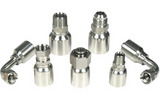
“Stainless hose fitting” describes material but not function. A buyer still needs to identify how the fitting grips the hose, how it seals to the equipment, which hose construction it is qualified to use, and what alloy and documentation the environment requires. Selecting alloy first can produce a corrosion-resistant part that does not fit the assembly. Define the hose-side retention method Perma
Connection Types

Choose Flared or Flareless Tube Fittings from Tube Preparation and Service Duty

Sep 28th 2023

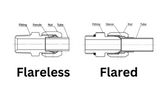
Flared and flareless fittings describe two broad ways of preparing and gripping tube. Neither category has one pressure limit, vibration ranking, or reuse rule. The correct choice is made from the specific fitting standard, tube material and wall, operating duty, assembly tooling, and the evidence that can be inspected after installation. Start with how the tube becomes part of the seal A flared c
Connection Types

Separate JIC 37 Degree and SAE 45 Degree Flare Fittings at the Seat

Sep 20th 2023

JIC and SAE 45-degree flare fittings can be confused because both are metal-seat tube connections and some sizes use straight threads that appear compatible. The decisive feature is the flare angle. A 37-degree cone and a 45-degree flare touch in the wrong location and cannot be converted into a controlled seal by additional torque. Identify the connection without using the machine type as proof J
Connection Types

Treat JIC and AN as Separate Specifications That Share a 37 Degree Interface

Sep 14th 2023

JIC and AN parts can share nominal tube sizes, straight threads, and a 37-degree metal flare. Those similarities explain why some components can physically mate. They do not make the two labels interchangeable procurement specifications, especially when aviation, defense, motorsport, or other controlled hardware requirements apply. Define the interface before comparing the product At the connectio
Connection Types

JIS and JIC Flare Fittings: Verify the Exact Japanese Connection Before Adapting

Sep 5th 2023

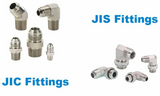
JIC describes a well-known SAE 37-degree flare family. JIS is broader: Japanese equipment can use several connection arrangements defined by different JIS standards, including 30-degree flare ends with BSP-family or metric threads. Calling every Japanese end “metric JIS” can be as misleading as calling it JIC. A correct replacement identifies the exact thread and seat on the installed part. Region
Connection Types

JIC Flare or NPT Pipe Thread: Match the Connection to Its Intended Seal

Aug 30th 2023

JIC and NPT can appear on opposite sides of the same hydraulic adapter, but they are not direct mates. JIC uses straight threads to clamp a 37-degree metal flare. NPT uses tapered threads and normally an approved sealant to contain fluid along the threaded joint. The correct selection starts with the existing port or line standard and the service requirements. Pressure alone does not assign one fa
Connection Types

ORFS Hose Connections and ORB Ports Solve Different Sealing Jobs

Aug 22nd 2023

ORFS and ORB are often placed in a side-by-side “which is better” comparison, but they commonly occupy different positions. ORFS joins a hose or tube end across two flat faces. ORB installs a fitting stud into a machined port. A system may use ORFS on the line and ORB at the valve or manifold through the same adapter. The useful decision is therefore where each seal belongs, how it will be service
Connection Types

Why JIC Still Works Well for Serviceable Hydraulic Lines

Aug 17th 2023

JIC fittings remain common because they combine a standardized 37-degree metal seal with a broad range of tube, hose, port, and adapter configurations. Technicians can disconnect the joint, see the sealing surface, and obtain many replacement shapes without introducing thread sealant at the flare. Those advantages are practical rather than universal. JIC must still be selected from the exact compo
Connection Types

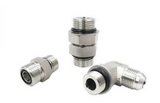
Use ORB for a Boss Port and JIC for a 37 Degree Line Connection

Aug 9th 2023

ORB and JIC frequently appear next to each other because a pump, valve, or manifold can have an O-ring boss port while the connected hose ends in a JIC swivel. The two fittings may use related straight-thread sizes at several dash sizes, but they perform different jobs and cannot seal by thread compatibility alone. The simplest distinction is physical: ORB seals an adapter into a machined boss por